Wednesday, 27 May 2009

Preparations for trip to Bulgaria and Finland

As I have already said the preparation started about two months before the actual flight. The most time consuming task was to study the aeronautical information publications (AIP) for the countries where I have never been before. I used Eurocontrol EAD (European AIS Database) Basic application which is available at (http://www.ead.eurocontrol.int/eadcms/eadsite/index.php.html ) and gives you access to AIPs of all European countries. I was interested especially in the following chapters: GEN 1.2- ENTRY, TRANSIT AND DEPARTURE OF AIRCRAFT and ENR 1.2-VISUAL FLIGHT RULES. For studying airspace I was using other parts of AIP together with Jeppesen maps and Jeppesen’s VFR FliteStar. For Serbia, Bulgaria, Romania I was using Jeppesen Low Altitude Enroute Charts which are used for IFR flying. In these countries one can fly only along published ATS routes and for any flying outside these routes one should obtain a special permission.

In the AIP of Bulgaria and Romania I found that I have to obtain a special permission to overfly or land in their territory. In order to get this permission I had to specify the planned arrival and departure and send them all relevant aircraft’s documents in scanned form. Surprisingly the Romanian CAA responded in few hours while I got the permit for Bulgaria only after several days. I would suggest to everyone who wants to get these permissions to first carefully study the prerequisites published in AIPs of these countries.

Another big challenge was Poland with its TSAs (Temporary Segregated Areas). It took me one whole evening and half night to prepare a route to cross Poland from south to north and from north-east to south-west on way back which was independent of current airspace usage in TSAs. Poland’s AIP defines a lot of TSAs which usage changes on daily basis and only at the day of actual flight one can be sure that he will be able to fly along planned route. The actual status can be obtained at Polish Air Navigation Services Agency (see http://www.amc.pata.pl/index.php?lang=_eng&left_menu=menu_amc&top_menu=top_amc&opis=amc_info ). On this page one can get the planned airspace usage for the following day besides the current airspace usage (see links Current AUP and AUP for Tomorrow). There is also an interactive map of airspace usage accessible under Elements of airspace/AUP. The AUP (Airspace Use Plan) for next day is available late afternoon day before but can still change and therefore one should check the status just before filling the flight plan.

Another big concern was the weather and I used several sources to first get long term forecast. I will discuss the weather issue while describing parts of the route later on. This time I was using www.meteoblue.com for the first time.


The GPS Track of Trip to Bolgaria and Finland


Trip to Bulgaria and Finland

In the following posts I will describe my longest flying journey so far from Slovenia to Bulgaria and then from Bulgaria to Finland and back to Slovenia. Back in December 2008 when I was attending UKOUG conference in Birmingham, UK, I was invited by Milena Gerova, The president of Bulgarian Oracle Users Group (BGOUG) to present at their spring conference which takes place at the end of April at famous Bulgarian ski resort Pamporovo. At the same time I was also invited by my friend Tuomas Pystynen from Miracle Finland, who is also a member of OakTable network, to present at “May Day” event which is organized just before Finish national holiday May 1st in Helsinki.
So the challenge to fly whole trip by myself was there. As it was a few days between those two events I would have enough time to fly from Bulgaria to Finland even in case that the weather wouldn’t be ideal and I would have to make several stops. It was obvious that this trip will be the most challenging not just because of still pretty unstable weather at the end of April but also due to crossing so many countries. Some of them are quite "exotic" (for aviation) and not very favorable for general aviation like Bulgaria and Romania.

My preparations started more than two months before the actual flight took place with general planning of the route and determining the requirements for flying in certain countries. The plan was to fly from one Slovenian international airport to Plovdiv(LPPD) in Bulgaria which was only about hour and half driving away from the BGOUG conference venue Pamporovo. This part included flying over Croatia, Bosnia and Serbia.
The second part of the trip would be from Plovdiv to Helsinki-Malmi (EFHF) in Finland crossing Romania, Hungary, Slovakia, Poland, Lithuania, Latvia and Estonia with refueling stops in Slovakia and northern Poland.
The last part of trip was return from Finland to Slovenia. Part of the way back home was the same as the route to Finland – from Helsinki through Estonia, Latvia and Lithuania to Poland with a refueling stop there and then through Czech Republic through Austria and Hungary back to Slovenia.

The GPS Track of Trip to Bolgaria and Finland


Sunday, 5 April 2009

Flowering Camellias and Magnolias in Locarno

My wife Lili likes very much flowers and years ago I have promised to her a visit to Holland in the time of tulips flowering. Unfortunately also this year it was not possible to fulfill the promise because in last week there was NATO summit in Strasbourg and the airspace around was closed. I hope I'll be able to visit Holland next year.
Last year we visited my colleague from OakTable Christian Antognini who lives in Ticino in Switzerland and they invited us to make a visit during the spring time when camellias and magnolias will be flowering. We were waiting for good weather and finally we decided to fly to Locarno (LSZL) on Saturday, April 4th.
As Switzerland is part of Schengen area also for aviation since end of March 2009 it was possible to make a direct flight from Divača (LJDI) to Locarno. The route was the same as last year. Unfortunately the bad weather and low clouds at 8000 feet prevented us to follow the planned route so we had to divert and the actual route was: LJDI-TRIESTE-GRADO-PORTOGRUARO-VIC (VOR) - ORI (VOR) - PORLEZZA - LSZL.
It was amazing that the weather in Switzerland was almost clear sky with only few clouds pretty higher than FL100. We passed Swiss border and descended to 4000 feet over Bellinzona and then preformed a straight in approach to Locarno.
The weather was sunny and warm and people were wearing just T-shirts what is not so common for my home place for the beginning of April.
First we visited Locarno Camellias Park which is located on the shore of Lago Magiore. I was expecting to see some beautiful flowers but I was wrong, it was much more. We came just in the right time to see all camellias in full flowering and it was awesome. My wife Lili was so surprised that she was hardly able to breathe. I posted some of the pictures I took in the park.
After visiting camellias we drove to "Parco Botanico del Bargarogno" about 15 minutes drive from Locarno airport. This garden has more magnolias than camellias and is located in a quite steep terrain between some nice small creeks. It was “once in life” adventure to see all those magnolias and also camellias in full flowering.
For the return flight I planned the same route as we actually did when flying to Locarno and I was right. The weather between Bergamo and Vicenca was pretty bad and the clouds were just high enough to safely clear the hills. From time to time it was raining and the temperature was just few degrees above zero. The last part of the route was most complicated as there was a shower between Grado and Trieste and we had to divert close to LIPQ and cross the border there.
It was a very nice trip although the weather was not perfect. I must here express my thankfulness to Michelle and Chris for preparing us this marvelous day.

Saturday, 25 October 2008

Visiting Denmark and Miracle Open World at Lalandia

Miracle A/S is a small company in Denmark, which every year among other events organizes a three day conference about Oracle database and is traditionally held in October. This event is now called "Miracle Open World" and is traditionally organized at Lalandia, near Rødby on Lolland island, Denmark. This year it was the second time I was attending this great event and decided, of course, to fly there. The event started at Wednesday, October 22nd 2008 and ended on Friday, October 24th in the evening. Because the weather at the end of October can be already pretty unstable I decided to depart to Denmark between the Saturday 18th and Tuesday 21st - on a day that the weather would be good enough to fly there without being forced to make some stops due to bad weather.
About 14 days before my departure I started to monitor the long term forecasts. They we changing a lot during fist 8 to 10 days, but after that it became clear that the best day for traveling would be Sunday, October 19th. I had to look for good weather to cross the Slovenian and Austrian Alps and also to be able to land in Denmark where the weather is like in England. All fronts which pass Great Britain are continuing to the east and then hit Denmark and other Scandinavian countries. Therefore I had to find a gap between these fronts. For this journey the most critical was for sure the weather.
The route planning showed that I will have to make a re-fueling stop and according to the prices of gasoline I decided to make a stop in Czech Republic where the price is about 1.20 EUR/liter. The best location would be in the area near Plzen so I decided to make a stop at Letkov airfield (LKPL) just few kilometers north-east of Plzen. Unfortunately the last evening I found that there will be most likely a fog next morning and therefore I found another airport more to the north - Žatec (LKZD). I called them by phone and asked them if I can do a refueling stop and if they usually have a fog in the morning. The answer was very encouraging, so I decided to change my route and land there.

From Divača(LJDI) to Žatec (LKZD) in Czech Republic
Next morning we (my wife and me) were in Divača before the sunrise and topped the airplane with the fule and we departed at 7:57 local time. The weather in Slovenia was excellent and also the weather forecast for Apls was good. Just before the departure I checked all web cams along the route and the weather appeared excellent.
The route to Žatec was: LJDI (the new ICAO code for Divača) - LJAJ (Ajdovščina) - ISTRI (border point with Austria) - LOLU (Gmunden near Salzburg) - DOMAL (border point with Czech Republic) - LKZD (Žatec). After departure we climbed to 9500 feet before we crossed the Austrian border and after that to FL115 to cross the Austrian Alps and then back to 9500 feet. The weather in Czech Republic was excellent, no fog and also landing at Žatec airfield after 2 hours and 59 minutes of flying was without any problems. Žatec has a grass runway 1120 meters long which is also used for training flights with jet aircraft and is in perfect condition. The guy at the airport office offered us some excellent cakes and coffee. After that we topped the airplane with Natural 95. They are buying this gasoline on a nearby gas station just 2 minutes away. The fuel consumption to Žatec was 82 liters what is very good for a 3 hour flight across Alps.

From Žatec in Czech Republoic to Peenemünde(EDCP)
The next route towards Denmark was: LKZD(Žatec) - DRN (Dreseden VOR) - EDCP (Peenemünde). I wanted to visit the Peenemünde museum about the development of V-1 and V-2 rockets during the Second World War.
Žatec is quite close to German border and after crossing it we were heading towards north to Peenemünde. The biggest airports in former East Germany are those in Berlin and they have pretty large TMA zones surrounding them. Therefore I asked for permission to overfly them at FL100 and got it. Already south of Berlin we encountered almost an overcast and also on the north side of Berlin the weather was the same. We were flying at 9500 feet and looking for a hole in the clouds to be able to go down and continue under clouds. Finally we found one big enough to go down safely. So I made a descending turn and entered that hole. Suddenly I found that my gyro-compass is turning around uncontrolled and also the artificial horizon is showing strange banking angle. A quick look the the vacuum pump gauge gave the answer - we lost the vacuum pump. There was another cloud layer down there so we had to find another hole to go down and continue flying towards Peenemünde. When we were below the clouds the visibility was quite poor and the clouds bases were at 1300-1500 feet so I had to make a decision what to do. We lost the vacuum pump and the weather was not very good and flying without attitude indicator and gyro-compass in such conditions wouldn't be very smart. So the best decision is to make a stop at the nearest airport. I pushed the "nearest" button on my GPS receiver and found that the closest airport EDBD (Dedelow Emmel Airfield) is only about few kilometers away. Therefore I contacted the ATC and notify them that we are landing due to bad weather and they gave me the frequency for EDBD airport. I called EDBD and immediately got the permission to land.
Dedelow Emmel Airfield (EDBD) is private airfield owned by Frank and Petra Emmel. Frank is a former airliner pilot flying now smaller airplanes. He was captain on Boeing 737 . Petra was secretary and now they are both running this nice airfield. Frank is also certified to make minor repairs on private airplanes and he helped me to diagnose whether we really lost the vacuum pump. Because it was Sunday afternoon there was no possibility to call some maintenance shop and therefore we decided to stay at Dedelow during the night. Their hospitality was so great that they offered us to sleep in their house and Petra prepared excellent spaghetti for us. Unfortunately Frank had to leave for Frankfurt later on so in the evening we had a great chat only with Petra. She told us about their dream to run their own airport and showed us also the album about their trip to Spain, Portugal and Marocco more than 20 years ago when Frank had only 22 hours of flying after getting his private pilot license. They are now running this airport for 3 years.
Next morning the weather was excellent and we called "Aircraft Maintenance" in Neubrandenburg which is only 15 minutes flying away and it turned out they had a spare vacuum pump. Petra prepared us and excellent breakfast and then we left this nice airfield. I must say that we were so surprised because they welcomed us in so nice and warm manner and were so kind and helpful in moments when we really needed the help. Therefore I must express my thankfulness once again also here that every reader will know how nice couple they are.

Repair in Neubrandenburg
The flight to Neubrandenburg( ETNU) turned into a short panorama flight because there were so many small lakes below us. Petra gave me a copy of the aerodrome map with the details for the VFR approach, so we had no problems to land there. We parked the airplane in front of the maintenance hangar and in few minutes Werner Ritter started to work on vacuum pump replacement. After 1.5 hours a new pump was installed and I made a short taxing on the apron to test the replaced pump and it was working perfect. Werner then gave us a lift to the nearest bankomat (ATM) to withdraw some money to pay the invoice. Also here in Neubrandeburg we found a very kind man, prepared to help immediately. While he was working he told me stories from his life in former Eastern Germany when he was maintaining Russian airplanes and helicopters.

From Neubrandebunrg (ETNU) to Roskilde (EKRK) in Denmark
Finally we started the last leg of our journey to Denmark. The route was ETNU - EDCX - Gedesby (Denmark) - Køge (EKRK VFR reporting point) - EKRK (Copenhagen Roskilde). After takeoff I switched to Bremen info and afterwards to Copenhagen info after crossing the Danish border. The flight took us only 1 hour 20 minutes, the weather was sunny almost without clouds, however, a strong wind from south west was blowing so the runway in use at Roskilde airport was 21. While we were landing there we had about 20 knots of head wind. We parked the plane on the apron and secured it.
Mogens Nørgaard, the technical manager of Miracle A/S came to the airport and gave us a ride to his home where we stayed for next two nights. During our stay at Mogens' house we visited Copengahen took the canal tour with a special kind of a boat. The only time I was in Copengahen was back in 1989 and at that time I found Copenhagen as one of the most beautiful cities in the world.

From Roskilde to Lolland Falster/Maribo (EKMB)
On Wednesday morning, October 22nd 2008, we had to move to Lalandia on Lolland island. We took some gasoline at Copenhagen-Roskilde airport and payed the landing and parking fees. The landing fee was 10,78 EUR and parking fee per night was 7,82 EUR, the price of the avgas was 2,38 EUR per liter. Because I was expecting to fill the tanks with mogas at Maribo airport I took only 21 liters of avgas.
The flight to EKMB was uneventful and we were flying at 3000 feet after clearing the Copenhagen TMA zones. We had only about 10 knots of cross wind when landing at EKMB. After landing I immediately payed the landing fees as I was expecting to fly home on Saturday when there is nobody at the aerodrome and it runs on a self-service basis what means, that you are landing or taking of on your discretion. The landing fee was 13,60 EUR and parking on the apron was free of charge.
After securing the plane we left for Lalandia, which is only about 8 km away on the Baltic coast. In the afternoon I came back together with Torben who helped me to top the airplane with mogas. We had to go three times to the nearest gas station which was about 2,5 km away. The price of the unleaded 95 was only 1,19 EUR per liter what was as exactly 50% of the avgas price.

Miracle Open World event
As this blog is dedicated to flying I will not write much about this event here. What is really important to say is that this was again a unique event with excellent program and great speakers. Most of them are colleagues from the OakTable.net. I am really admiring Mogens and his wife Anette for excellent preparation of the event with the best social program. Mogens always jokes that the Lalandia events have 80/80 ratio - 80 percents of the time is conference program and 80 percents of the time is the social program - and this is possible only because we sleep so little.
As my small contribution to the social part of the event I brought 15 liters of new wine "Teran" and warned everybody that he shouldn't spill it because he will not be able to remove the spot from the cloths.
I had my presentation in the first slot on Thursday and after that I was able to attend other sessions. Thursday evening we had gala dinner and after the dinner at 22:00 we moved to the swimming pool until 01:30 where the rest of the social program was taking place.
The last day we started at 9:15 and ended at 16:00 with the wrap-up session.

From Lolland to Letkov (LKPL) in Czech Republic
On Saturday morning we left Lolland Falster/Maribo airport at 9:21 local time and headed towards Czech republic. The weather was excellent and we climbed to 8000 feet. In Northern Germany the weather was pretty nice, however, towards the south there was cloud layer with tops at 4000 feet. It was not a complete overcast so it would be possible to descend in case of emergency. The sky was clear of clouds near Czech border and also in Czech Republic. I planned to land at Letkov aerodrome near Plzen where they have mogas. It took us 3 hours and 16 minutes to LKPL and all the time we were flying at 8000 feet except the last 15 minutes when we descended to 4000 feet and later on to 3000 feet. After entering Czech Republic we switched to Karlovy Vary radar (LKKV) and later on to Praha info and finally to local frequency of Letkov.

The route was: EKMB - MIC VOR - PAH NDB - LEG VOR- EDCJ - KONAR (Czech border) - LKPL.

Letkov is a nice airfield used mostly by gliders but there are also many other airplanes. We topped the aircraft with mogas and checked the weather in Austrian Alps and Slovenia. I also phoned to Divača and found that a strong wind ("burja") is blowing at my home airport gusting to 35 knots.

From Letkov (LKPL) to Portorož (LJPZ) in Slovenia
The route to Slovenia was: LKPL - DOMAL(Czech border) - RENKA(Austrian border) - VIW VOR - ISTRI (Slovenian border) - LJDI - LJPZ.
After departure we headed towards south. At DOMAL point we crossed the border with Germany and soon after that we crossed Austrian border at RENKA. The weather was nice, however all the northern part of Austria was covered with an overcast of clouds. We climbed to FL115 and were flying directly to the VIW VOR which is close to Klagenfurt. The Austrian Alps were almost without any clouds and surprisingly almost all valleys were without cloud layer. The view was gorgeous and we took some pictures which you can see here. Also Slovenia was covered with a cloud layer except the highest mountains. Only the "Primorska" region close to the border with Italy was clear of clouds as there was blowing a strong wind "burja". In Slovenia we descended to 9500 feet and then to 7500 feet and when we were close to Divača (LJDI) we contacted Divača info and found that the cross wind is blowing at 25 knots gusting to 35 knots. I decided to proceed to Portorož (LJPZ) where there was almost no wind and
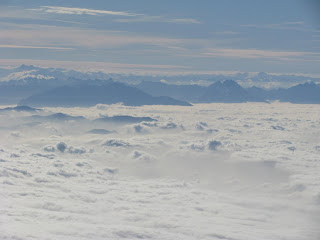
also clear sky. After landing there we took a small late lunch and then contacted Divača by phone. In the mean time "burja" slowed down to about 15 KT what are for me "normal" conditions there. So we filed a flight plan and departed back to Divača, where we landed after 15 minutes. The wind was almost calm at the ground level, but we encountered pretty strong rotors in base and final.

Lessons learned
The most important thing I learned from this trip is that you loose your instruments in the most inappropriate moment. I could paraphrase the Murphy law as: "Murphy is standing out there and waiting for you!". Maybe even more important thing we found was that there are still many kind and helpful, hospitable people who are willing to help you in troubles. Thanks God for them!

Romantic Wedding In The Airplane


On October 4th 2008 my flying instructor Matej Cerar married with Ana Skok. The reason why I am blogging about this event is the romance behind. They were dating before for many years. Ana is also employed in the "Janez let Flying School". My first conversation with her at the time when I was deciding, which flying school to choose, was crucial. At that time back in May 2007 she convinced me that "Janez Let Flying School" is the right school for me. And she was absolutely right. She is also a student pilot. I met Matej few days later and he was my instructor through the whole training for PPL.
This year they finally decided to marry and they asked me to sing "Ave Maria" in the church during the wedding ceremonial. I was really deeply honored by their invitation and also happy for them because they wanted to confirm their relationship also before God in the holy sacrament of marriage. For those, who don't know the marriage procedure in Slovenia, I must explain that we have so called "civilian marriage" which is the official one for the civil authorities and we have also so called "church marriage" what is a synonym for the holy sacrament of marriage in the Catholic Church.
They decided that the civil marriage ceremony will take place in the airplane.

On October 4th we gathered at Divača airport (LJDI) and first we had a very nice welcome reception in the hangar. Unfortunately this day a very strong cross wind "burja" was blowing gusting to over 25 knots and therefore Matej's father Marjan, who was the pilot in command, made a good decision not to really take off in a strong cross wind but just do the slow taxing on the runway. I took these two pictures of this nice couple when they were already husband and wife.

The church marriage ceremonial took place in Tunjce near Ljubljana airport. The weather was nice and we could see airplanes landing at the airport. I asked my wife Lili to sing with me the famous Psalm 23 "The Lord Is My Shepherd" what we have already done before for several occasions. Besides "Ave Maria" I performed also "Panis Angelicus".

The wedding party took place near Medvode. All pilots who were invited to the party were siting at one big round table, so there was plenty of opportunity to have interesting chat about flying besides all other entertainment going on whole time. It was a really a very nice wedding.

One again I must express my thankfulness to Ana and Matej for the invitation. We all wish them a long and happy marriage life.

Tuesday, 30 September 2008

Night Rating

Yesterday evening (September 29th 2008) I had the practical exam for the night rating. I started with the training last Saturday evening. According to the syllabus one needs at least 5 hour of flight training in night conditions for night rating. Months ago I attenede the theoretical part of the training.
Since I got my PPL(A) there were several occasions when it would be much easier if I would have night rating at that time. All these occasions were one big struggle with the time in order to land before the official night starts (sunset + 30 minutes). Now fall is coming in and the days are getting shorter and I have still some journeys to fly. Therefore the night rating was something what would make my life much easier. I really don't plan to fly much during the night as it is not a very good feeling flying in a single engine aircraft and experience an engine failure. But it is a good extension for your flight when you can prolongate your daily VFR flight into night VFR and land at the destination airport some short time after the official daylight conditions end.
I started my first night training on a brand new Cessna 172SP with the glass cockpit, which has only about 200 hours. Although I have over 62 hours on C172 , the new glass cockpit environment was a very unpleasant time for me. Also flying in the night conditions was something new for me. But the biggest change was the glass cockpit. I attended a several hours training before my first flight but obviously this was not enough for me. I felt so uncomfortable that my overall performance was significantly reduced.
My instructor was Matej Cerar from "Janez let" flying school, a great young man, who tries to transfer all his knowledge to his students. He was my instructor for my PPL(A) as well. We departed from Divača just before the sunset and continued to Ljubljana airport (LJLJ) where I had performed my first night landings. The first one was not a very smooth one, however, all others were good enough and those without flaps were the best ones.
Next morning, it was Sunday morning, we departed early and performed a touch-and-go and then proceeded to Divača where we landed already in daily VFR conditions.
For my next training I chose the old Cesna 172 which I was using during my training for PPL. What a relief! Known environment and behavior! Yesterday evening we departed from Divača before the official night started and again flew to Ljubljana airport. Then I was performing traffic patterns more than one hour to gather enough practice. After landing, I had a briefing with the examiner Aleš Štimec and then we departed on the night exam flight across half of Slovenia. It was a gorgeous night without moon and there were no clouds. After departure from LJLJ I had to make a short diversion to Ljubljana city where I was climbing to 8500 feet while waiting that the IFR traffic will land at LJLJ. After that the route was to DOL VOR, Polzela, Trebnje, Velike Lašče, S3 and LJLJ. At the end I had to perform two landings, one was with landing light and flaps, the other one was flapless and without any light in the cabin. I was tempted to use the battery, however, I decided to land without being able to see the instruments. Of course, the examiner had a GPS receiver in front of him, so he was able to monitor the airspeed. And surprisingly, the landing was very smooth.
Finally, after 1 hour and 38 minutes, the exam flight was over. I passed. After the de-briefing we finally left airport after midnight.

Thursday, 25 September 2008

SIOUG2008 Conference in Portorož

From September 21st to 24th the Slovenian Oracle Users Group - SIOUG - annual conference was taking place in Portorož (LJPZ), Slovenia. As many already know I am working with Oracle products now for 20 years, so this event is really important for my business.
This year I was able to fly to Portorož from Divača what is only a 20 minutes flight. It was nice to have my Piper parked so close to the conference venue.
On Saturday, September 20th, a colleague from OakTable Riyaj Shamsudeen with his beautiful wife Nisha and 6 year old son Imran arrived to Ljubljana airport and they were staying in my house. On Sunday the young Imran flew with me to Portorož.
On Monday afternoon I invited some of my customer for a panorama flight over Slovenian Adriatic coast. On Tuesday , I had to fly to Ljubljana airport (LJLJ) to pick up another colleague from OakTable Carl-Jan Engel from Netherlands. During the flight back to Portorož he took a short video while we were landing. I used this video instead of the introduction in my keynote speech on Wednesday morning.
I have removed the original sound and replaced with a record from one of my solos when I was singing in octet "Oktet Hoja" years ago. I hope you will enjoy not just the picture but also the sound.

Tuesday, 16 September 2008

FlightMap Slovenia

In the spring 2008 I was preparing for flying in Switzerland and at that time I found on the web a very nice page called Flightmap Switzerland, which was prepared by Pascal Dreer. I contacted him in August and asked him for permission to use his JavaScript code as a base for a similar application for Slovenia. He generously granted me the permission and I started to develop the
application in the middle of August. Unfortunately I have some public appearances in September and October, so my time was limited and therefore I decided to currently prepare just a beta version of FlightMap Slovenia. Currently it is located on my home web page, but eventually it will be relocated to its own domain. In future more data will be added to this page.

The idea was to prepare a web page where all the official aeronautical data for Slovenia is visualized and can be easily accessed. The second goal is to put all available meteorological data to the same map - like radar and satellite images and also weather forecasts in the form of predicted winds and clouds/precipitation layers.
One very useful information I frequently use are the web cams. If you can see a part of the sky you get the most recent information about the actual weather there and this can be quite helpful especially in those cases where you are still not sure if you should depart or not. So the web cams are also one of the layers in my application.
I also obtained some other data from Sloveniacontrol d.o.o., the Slovenian ATC, and Slovenian CAA at Ministry for Transport where I got the detailed coordinates of all air-stripes in Slovenia, which are also published on the Jeppesen VFR map for Slovenia.
The layout of the original Pascal's page was retained, however I had to change things behind and develop all the interfaces for obtaining weather information from XML sources at Aviation Data Center and official Slovenian Meteorological Agency. Completely new is the mechanism for displaying raster data - like animated images from radar and satellite. A lot of time was spent in preparation of digital borders of Slovenian airspace and obtaining data about airports.

As with any database, also this has certain errors or inconsistencies. Therefore I am fully thankful to everybody who will report any data faults and with this help to improve the data quality. And using the data (the application) is the only way how one can find out some data inconsistencies.

Therefore any comments, ideas and bug reports are most welcome!

Thursday, 28 August 2008

Gift for my mom - Trip to Salzkammergut and Zell Am See (LOWZ), Austria


On August 4th 2008 my mother Jožica (Josephine) celebrated 83rd birthday. She is is a big fan of nature and especially mountains. She likes to hike despite her age. Last year, after I got my pilot license, I took her on a sightseeing flight to Triglav (2884m), the highest Slovenian mountain. She was so happy that time that I decided to give her a special kind of a birthday gift this year - a flight across the Slovenian and Austrian Alps to Salzkammergut in Austria, Salzburg, with a short stop at Zell Am See (LOWZ).

The weather forecast for August 7th was excellent and we departed early in the morning. The route was: Divača - LJAJ - KANIN - ARNOS - LOSM - Gmunden - Mondsee - Hallein - Koenigsee - LOWZ. Over alps there were some clouds between FL90 and FL100 so I decided to climb to FL110 and later descen to FL100. The weather in Salzkammergut was even better - the visibility was more than 100km. Two years ago I visited Salzkammergut with car, however, the view from the airplane was much more fascinating. I was astonished by the color of the lakes which seemed so surrealistic - a color that you usually don't see many times. My mother was silently enjoying this beautiful sight.
At Gmunden we turned to the west towards Mondsee lake. The church in Mondsee village was used for the wedding ceremony in the famous movie "The Sound of Music" which won the Academy Award for Best Picture of 1965 and is one of the most popular musicals ever produced.
Further on we were flying abeam Salzburg city towards Koenigsee in Germany. We overflew Eagle’s Nest, the famous Adolf Hitler’s residence near Berchtesgaden and continued to Zell am See (LOWZ) airport, which is located near a lake between high mountains. Just few kilometers away is Kaprun, very well know skiing center and also know because of the tragic accident which happened years ago.
We took a short walk towards the Zell am See village and had a lunch in the airport's restaurant. In the afternoon some cumulus clouds start to gather over the mountains so I decided to depart as soon as possible. LOWZ has an interesting traffic pattern which avoids populated areas. When departing you must first climb to 4000 feet in traffic pattern and only then you can leave it in the desired direction.
On the way back the clouds already obscured the highest mountains so we had to fly more to the east to gather more altitude and also there were less clouds. The route back to Slovenia was almost the same as that one in the morning with a small exception - we first landed at Bovec (LJBO) airfield in Slovenia for a short stop.
After landing in Divača I called my father, age 86, to notify him, that his beloved wife is still "alive" and in "one piece".

Wednesday, 27 August 2008

A trip to Brač island (LDSB), Croatia

In the middle of August I decided to fly to Brač (LDSB) in Croatia for a few day stay there. I visited Brač once before, but just as a safety pilot, so this was really my first landing at LDSB. My wife was with me and we had a wonderful sightseeing flight over hundreds of islands in Adriatic sea.
I asked my wife to make a video of final approach and landing at LDSB. Unfortunately, the camera setup was wrong, so the movie resolution is not very good.
After three days we were flying back to Portorož (LJPZ) and Divača. The weather was quite windy and at the seacoast Tramontana was blowing with more than 25 knots. Brač airport is located on the top of the island at altitude of 1776 feet (541 meters) . The wind was not so heavy here but there was a lot of wind shear all over the runway. This time the camera setup was ok. After passing the end of the runway the terrain quickly goes steeply down to the see and there we experienced, as I was expecting in advance, a bumpy situation when we entered in heavy crosswind of Tramontana. In the background one can see Hvar island.